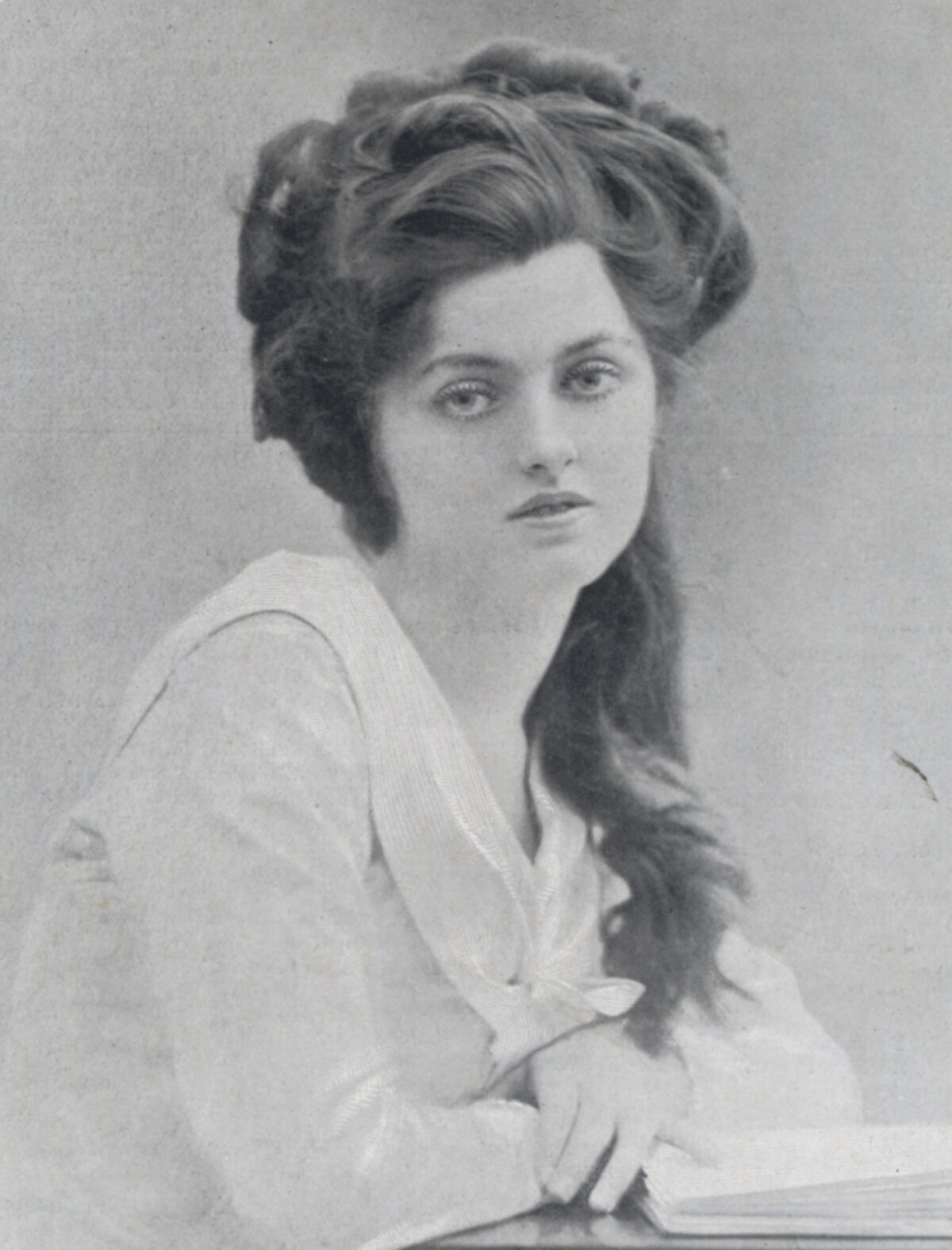
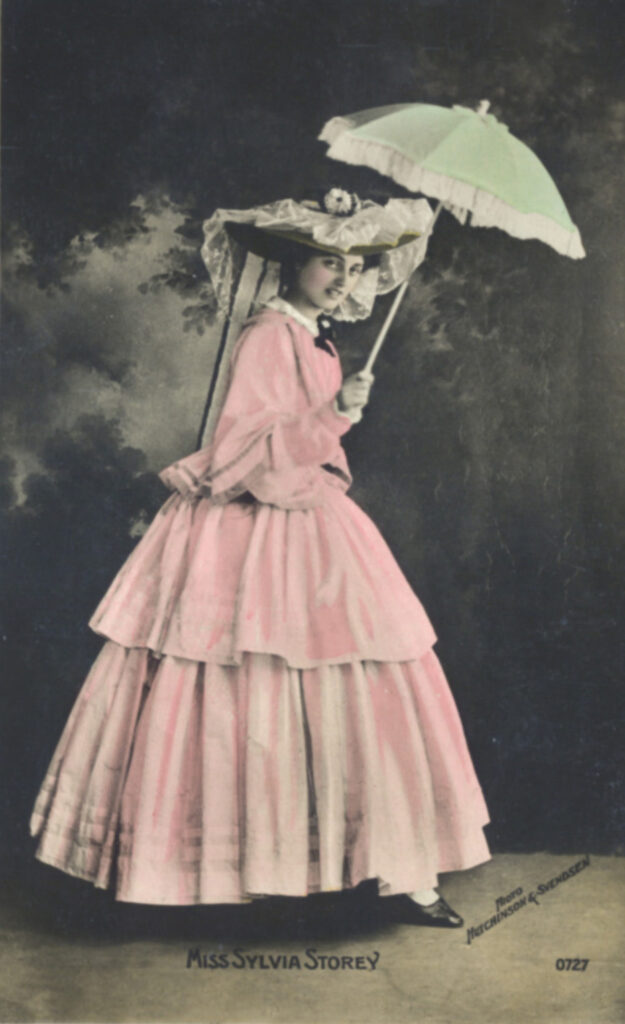
Sylvia Storey was a British stage performer associated with Edwardian musical comedy. She was linked to the Gaiety Theatre, London and hence was known as a “Gaiety Girl.”
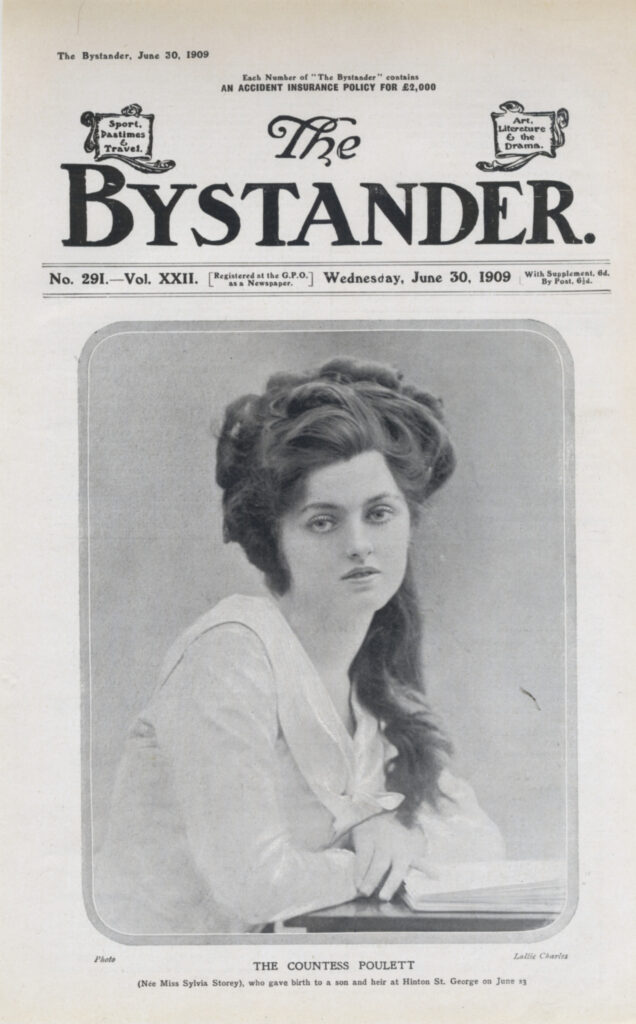
The image at the top of the page comes from an edition of The Bystander dated June 30th 1909 by which time Sylvia had become the Countess Poulett. She married in 1908 and she and her husband travelled around the world. William Poulett, 7th Earl Poulett died in 1918 during the flu epidemic.
After she was widowed she became a socialite spending time in the United States. While spending time with Coco Chanel and the Duke of Westminster on his yatch, the Duke’s wife became jealous and threw Poulett’s belongings overboard.
In later life she took a cottage in Somerset.
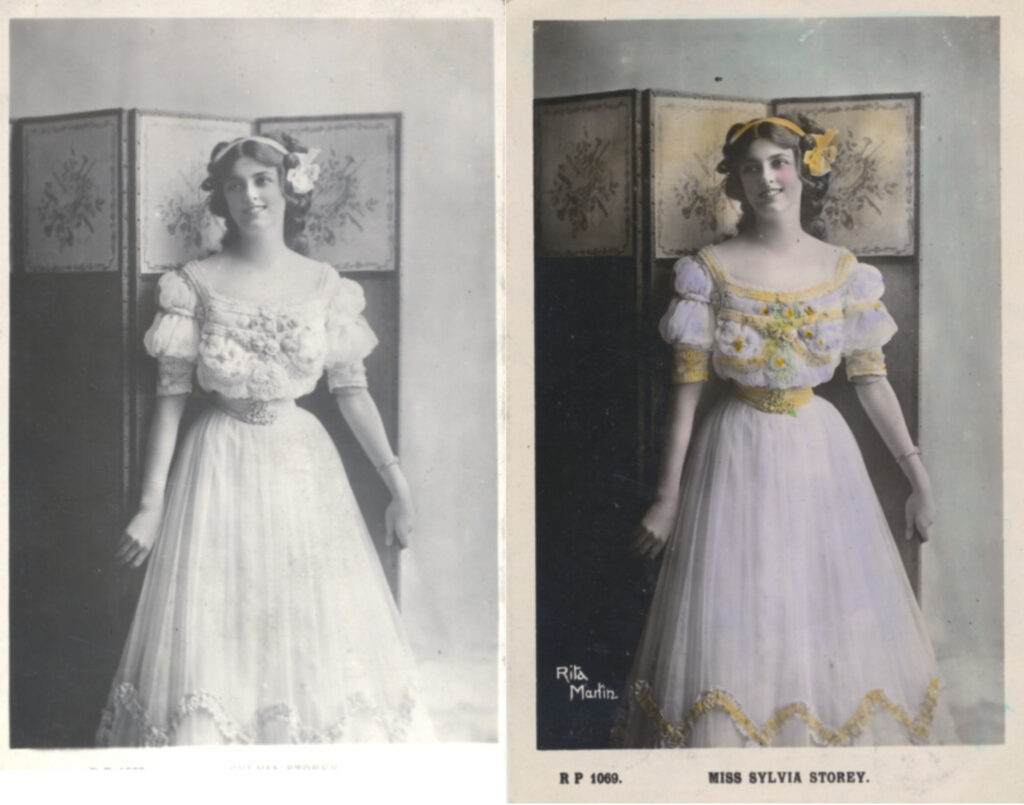
Gaiety Girls were to be seen in chorus lines and were reputed to be more refined than other dancing girls in the music hall. As well as dancing they often posed for postcards and cigarette cards. Above you can see Sylvia in both black and white and colourised. Purists tend to frown on the practice of colourising old photographs today but it was common practice in the early twentieth century. The process of colourisation was carried out by “hand tinting” though this effect was was achieved in different ways.
The practice of hand tinting will be described in more detail in a later post. There will also be more information about Gaiety Girls. Sylvia Storey was far from the only Gaiety Girl to marry into the aristocracy.
Here’s another colourised card of Sylvia Storey. There are many more postcards of Sylvia out there and I will be adding them from time to time.
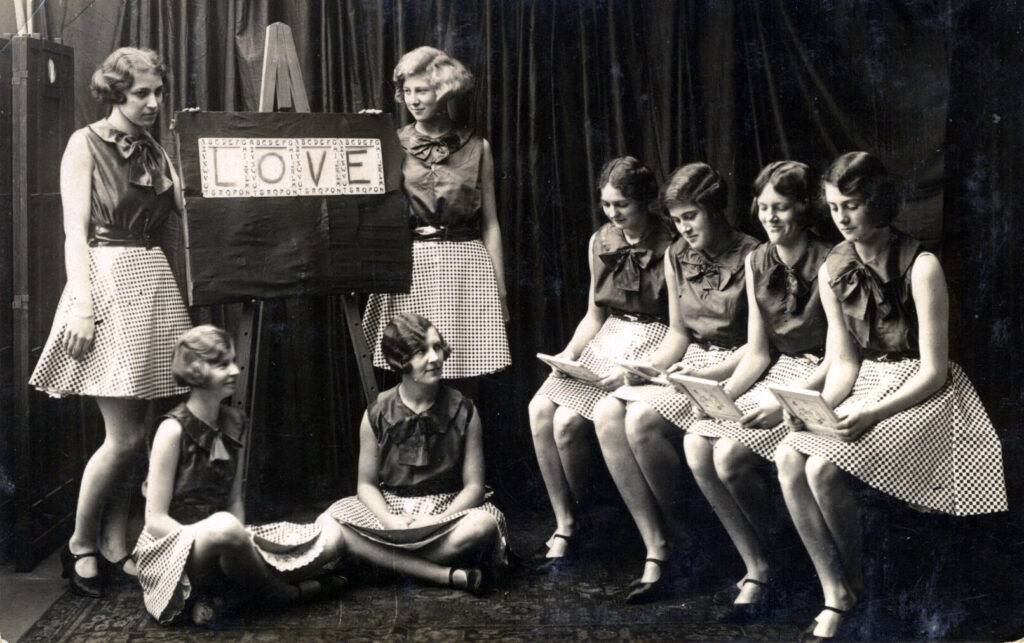
A series of four photographs all from the studio of Arthur Winter of Preston. This one has a date of 1935 on the reverse and handwritten “The Maid of the Mountains.” It turns out that “The Maid of the Mountains” was a successful light operetta performed often in the first half of the twentieth century by various different companies and troupes. A search of the British Newspaper Archive reveals the following advertisement:
So, although I can’t be certain, it seems likely from the date that the photograph is of the chorus from the Preston and District Amateur Operatic Society.
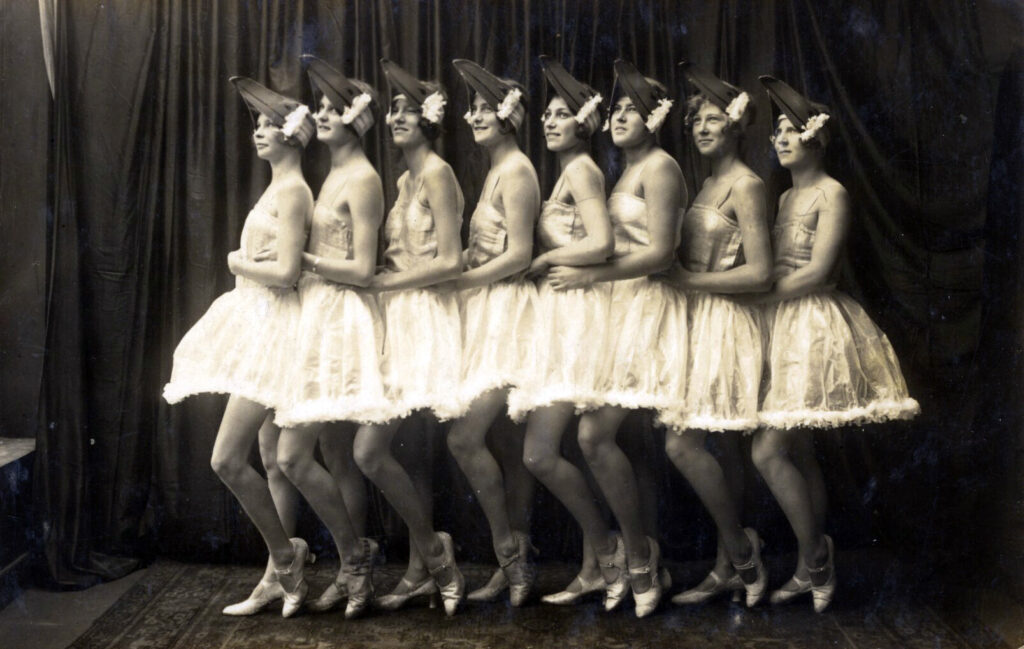
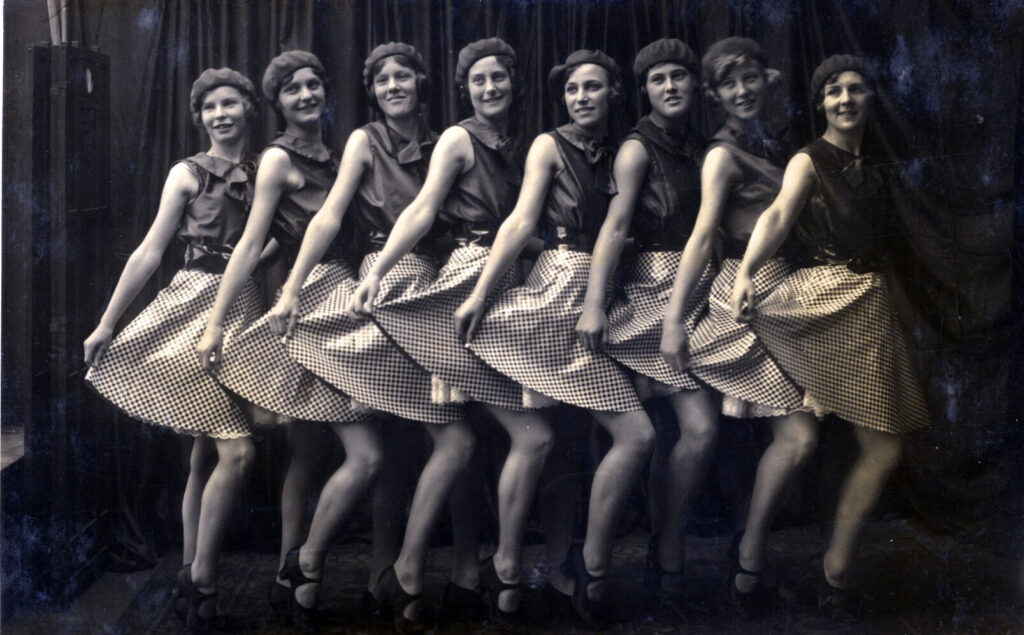
Three further photographs from the same studio and date are probably of dancers from the same Society.
Not sure how I feel about “AI” generated videos from old photographs but the results are always interesting. The software seems to have invented some extra dancing girls for “The Maid of the Mountains.”
A second video generation seems altogether unlikely and too modern in style.
I recently obtained a 2 page article from The Sketch magazine dated September 18 1895 interviewing John Tiller and giving lots of details about his training methods and troupes. I’m constantly amazed by how many dance troupes he trained and named. As time went on he basically franchised his brand to other trainers so we may never have a full list of the troupes trained in the Tiller method.
Quotes from the article are all shown in italics. The images are also from the article.
“Who has not heard of John Tiller of Manchester? But some of us may not have chatted with the energetic and genial manager whose name is so intimately connected with the troups of dancing and singing girls who in fours, sixes, eights, and sixteens, raise out spirits as high as they kick their heels in the maddening whirl of skirt which adds to the abandon of their style. “
“To go to Manchester without calling on Mr Tiller would be like going to Westbourne Grove without paying Whiteley’s a visit – they both have something to do in the way of skirt-providing, by the way.“
I didn’t get the reference to Whiteley’s but wikipedia tells me it was an early department store that grew out of a dressmaker’s business. Hence the reference to “skirt-providing.”
“As long as our girls are respectable and respectably conducted we don’t lay too great stress on drawing from any special class. We don’t send them out before eleven. You say that’s full early; but remember that we have them educated under proper governesses, for we hold that cultivation of intellect is necessary to learning dancing.”
It’s surprising how young some of the Tiller Girls were and there are many questions to be asked about their welfare and treatment. On the other hand becoming a Tiller Girl was one of the few ways that working class girls could escape from their backgrounds. Although I don’t think she was ever a Tiller Girl, Jessie Matthew’s career, as given in her autobiography, was very much one of a working class girl finding escape through dance.
“Of course, you supply individual dancers?”
“Rather,” he replied with a confident smile. “Miss Ethel Neild, now at the London Lyric, comes from our school; Miss Any Knott will be principal boy at Huddersfield next winter; and Miss Bessie Cohen and Miss Maggie Rimmer are well-known soubrettes and dancers of pas-seula all over the provinces; while, if you have space, you might mention “Little Blake,” “Little Annie” and “Little Burnett,” who have been particularly successful in their “single turns.”
“I notice that you name your troupes differently. There are “The Fairy Four,” “Tiller’s Troubadours,” “The Forget-Me-Nots,” “Tiller’s Mascottes, “ “The Rainbow Troupe,” &c. What distinction is there between them?”
“Very little, except that each troupe has its own speciality. “The Tiller Troupe” is composed of our tallest girls, and “The Forget-Me-Nots” are the smallest; but they all dance and sing. They can do “cart-wheels,” the “splits,” and the high kick – indeed, everything that is done in fantastic dancing.”
The Sketch article is a great resource and all the more valuable for being contemporaneous with Tiller’s early work. By listing some of his dancers and the venues they appeared at, the article also adds to our knowledge of the music hall venues of the day. Who knows what else is yet to be discovered?
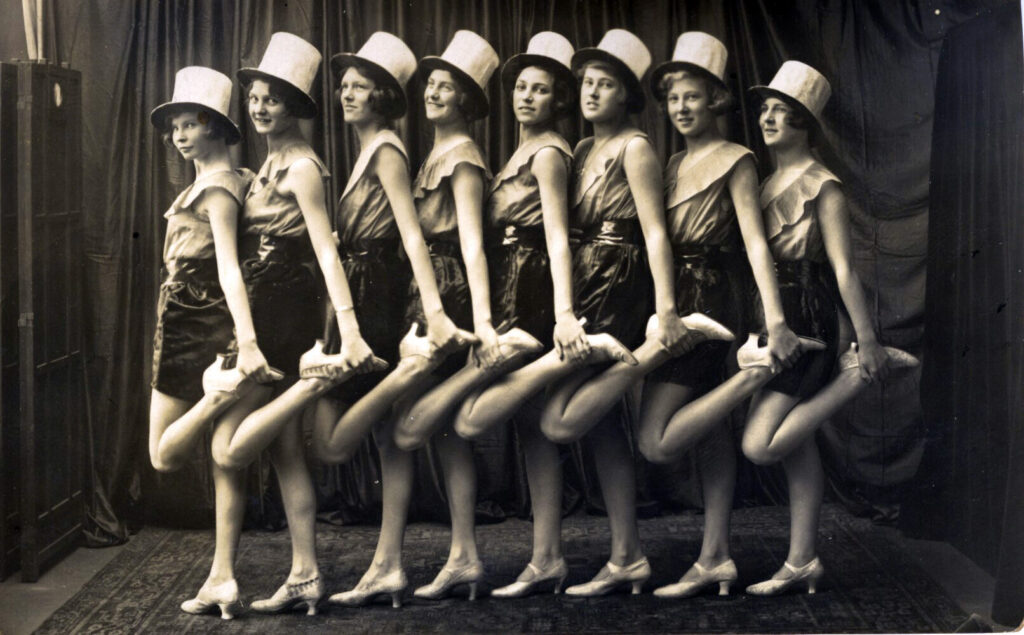
Egham is a town in Surrey adjacent to Runnymede where the Magna Carta was signed. The four photographs in this post were taken at the Studio, High Street, Egham. Date is unknown but I’d guess the 1920s or 30s.
The unusual thing about these dancers is how elaborate their costumes were. I don’t suppose they went to such lengths just for their own amusement so it’s very likely they performed in Music Halls or variety theatres. It’s possible they were in a local pantomime though again their elaborate costumes suggest something grander.
Of course there’s the perennial problem that the studio where the photographs were taken is not necessarily where they are from. If the troupe were touring then their home location could be anywhere.
Once again we’re confronted with the fact that there is insufficient information to identify the dancers or where they performed.
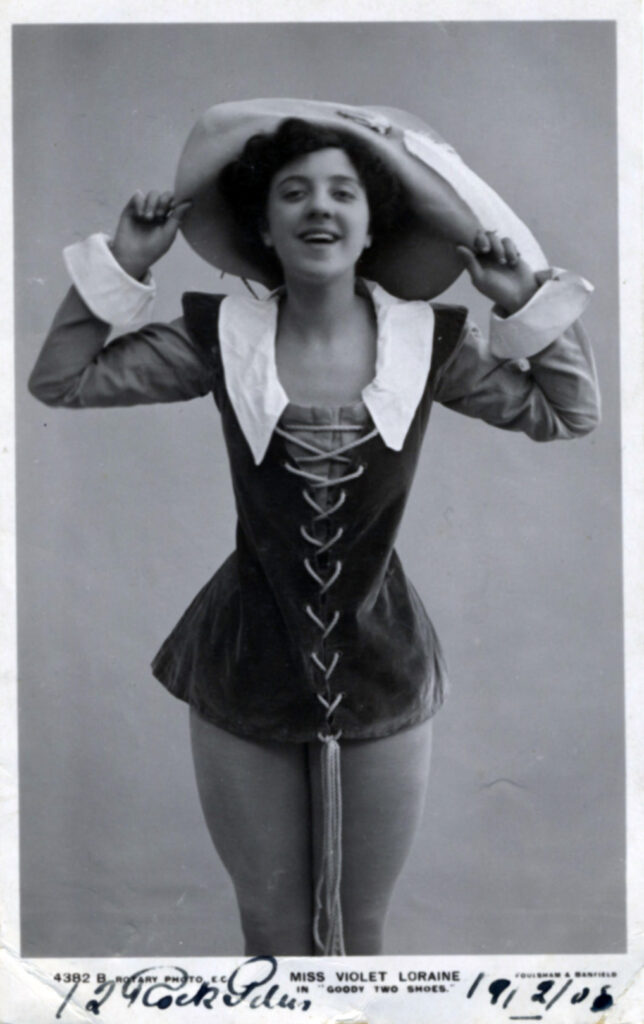
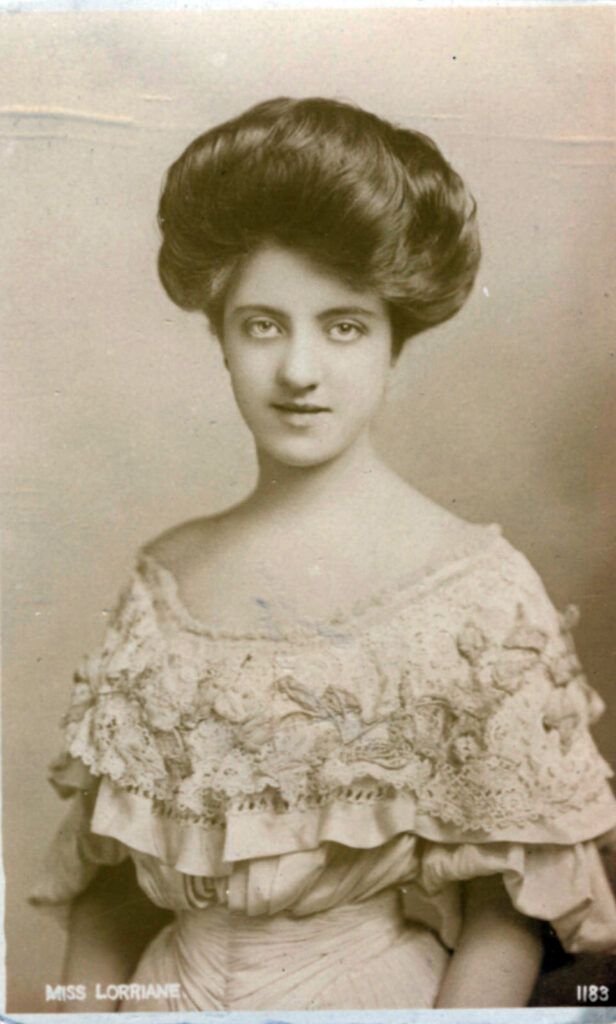
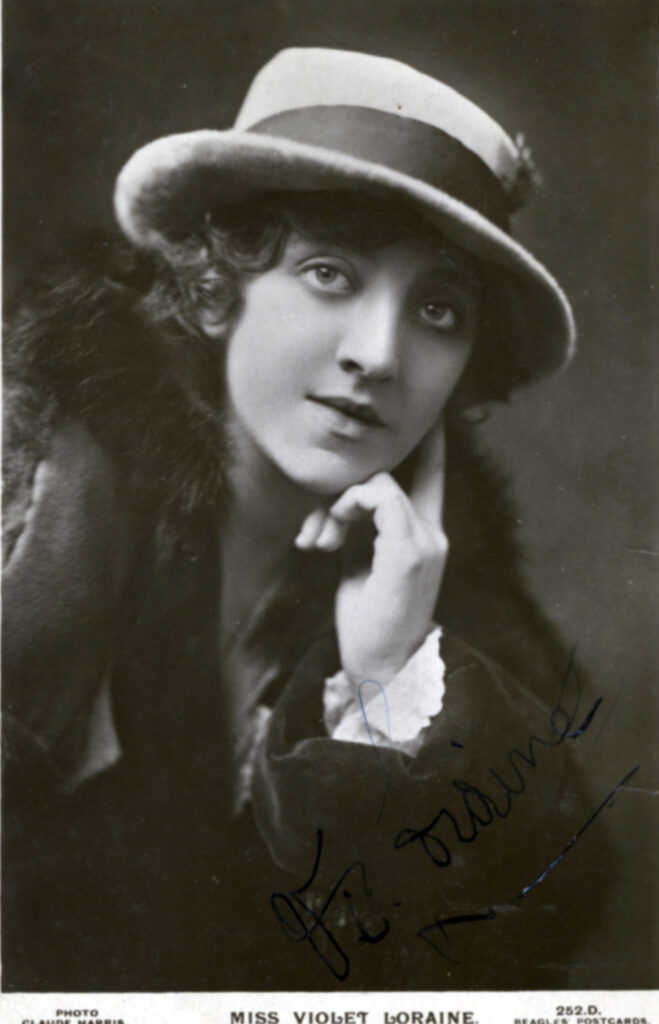
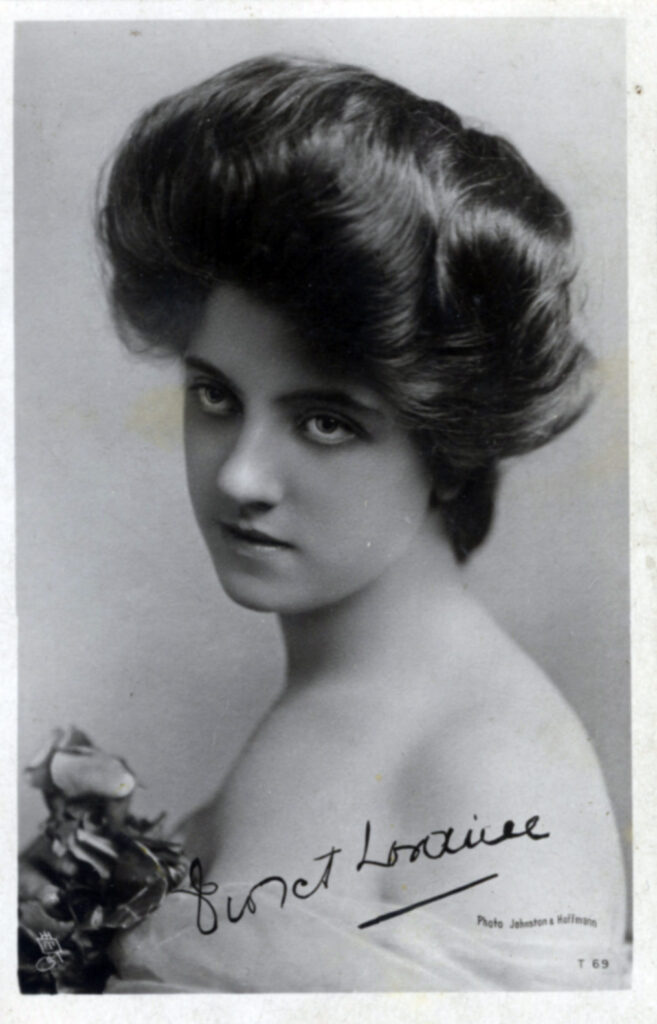
“So often it’s hard or impossible to find out anything about music hall performers who appear on Real Photographic Post Cards. In the case of Violet Lorraine there’s a fair amount of material to be found. Wikipedia tells us:
She was born Violet Mary Tipton in Kentish Town, London, in 1886 and went on the stage as a chorus girl at the age of sixteen. Her rise to fame came in April 1916 at the Alhambra Theatre in the musical/revue The Bing Boys Are Here. She was given the leading female part, Emma, opposite George Robey playing Lucius Bing. It became one of the most popular musicals of the World War I era. She retired from the stage on her marriage on 22 September 1921 to Edward Raylton Joicey MC (1890–1955) and they had two sons, John and Richard. She returned to acting for the screen, appearing in Britannia of Billingsgate (1933), a musical based on the play of the same name by Christine Jope-Slade and Sewell Stokes, followed by Road House in 1934.
Violet Mary Joicey died in Newcastle upon Tyne in 1956, eight days short of her seventieth birthday.”
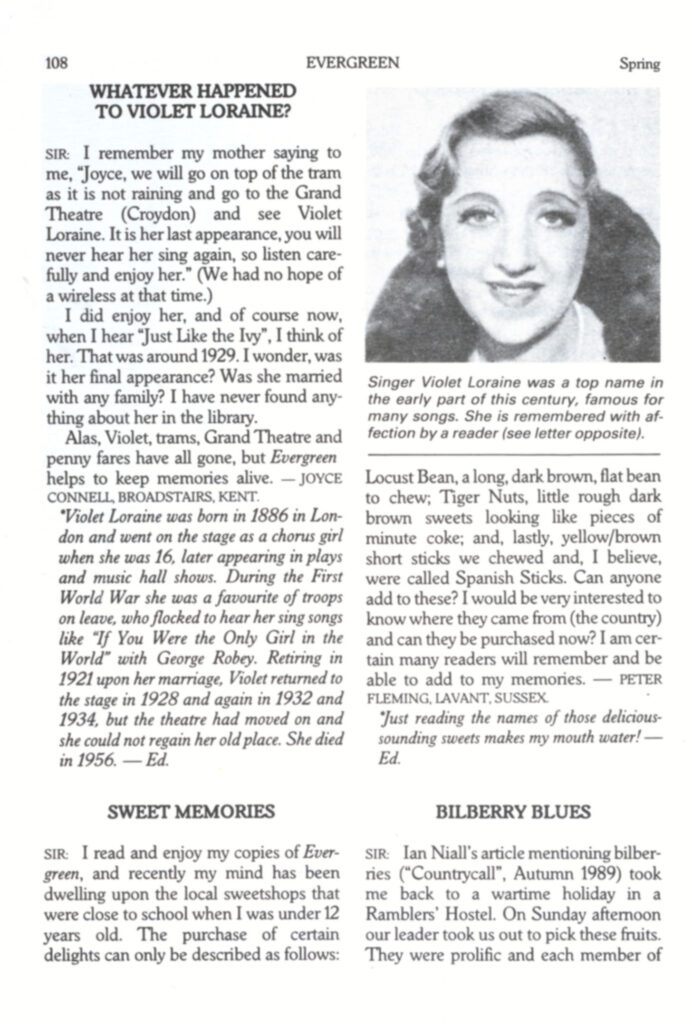
Further information can be seen in this article from an old magazine:
Violet was famous for singing “If you were the only girl in the world” with George Robey. You can hear her singing if you search her name on Youtube.
I’ve shown the RPPCs in my collection but there are lots more out there.
Finally, and I don’t know whether to believe this, the John Peel Wiki claims that he played played her track, ‘When We’ve Wound Up The Watch On The Rhine’ on his radio show.