Categories
photography Social history war

Photograms of the Year 1941: but Don’t Mention the War

It’s the middle of the war and this photograph is the only one in “Photograms of the Year 1941” related to wartime. Everywhere else it’s business as usual. An introduction was added after the volume was assembled and includes the following: “The fact that it includes practically no photographs of warlike subjects is an indication of the place that real picture-making holds in the hearts of the people who practice it. Camera records of various phases of the war at home and abroad may be left to the Press photographers whose business it is, through the illustrated papers and the newsreels, to show the world realistic details of what is being done to the world under arms.”

I take this to mean that only the kind of photos included in the volume are to be considered “real picture-making” whereas war photography is not. This seems not only wrong to me but ignores the artistry of war photographers and the documentary tradition. A corrective for today might be to look up World War II photographers using wikipedia though I note the omission of Lee Miller from both World War II photographers and holocaust photographers. (Her individual entry gets it right though).

Landscape in pictorialist style is well represented as usual as are still lifes:

There are the usual nudes and figure studies. For instance this example of using a classical reference to present a nude:

Personally I find “Idol” to be a much more appealing image and I note that, once again, the female nude is just as likely to be taken by a female photographer as a male one at this time.

“Cherry Time” is another example of the use of classical reference and a pictorialist style.

You won’t be able read the above but it is an example of 21 pages listing camera clubs in the UK which perhaps gives an indication of how popular photography was as a hobby, even in the midst of war. I note that the camera club to which I belong today was listed as being operational in 1941.

Categories
photography Social history

Photograms of the Year 1952: The Wonderful and Weird

The 1952 edition of Photograms of the Year contained the usual, sometimes odd, mixture of themes and styles. Pets continued to be popular subjects proving that cats and dogs ruled long before the advent of the internet. We forget that at this time getting a photograph published was only for the professional photographer or gifted amateur whereas today anyone can post on facebook, instagram and many other platforms no matter how good or bad their work is.

The photo of the black cat is entitled “Actor?” and is by Felipe Maiaru.

As usual, pictorialism is well represented as seen in Copmere by John D Jones and Dawn Departure by H S Newcombe.

I’m always complaining about weird photos of children and old men or ethnic types with lots of wrinkles in these older publications so it’s only right I’ve included examples to show what I mean. Ethnic wrinklies are still popular today whereas it’s difficult to imagine anyone publishing photos of crying infants. (I think I can say wrinklies because I am one myself.) You’re seeing Breaking Point by Ann-Marie Gripman and The Painter by Holt Madson.

Fireside Beauty by Karel Jan Hora is more aesthetically pleasing perhaps. And if you’re here for the nudes:

You’re looking at Juno by Joan Craven and Low Key by W.A.J. Paul. The notes that go with Juno say “Nude photography is one of the most difficult branches of photography with many pitfalls, but when it is successful it is usually more than justified. It must be idealised in some way or it merely becomes portraiture without clothes, which would not be regarded, to say the least, as in good taste.”

Finally you could expect to find several pages of advertisements at the end of each edition of Photograms of the Year. Often the adverts were surprisingly wordy though this one let a striking image do the talking.

Categories
photography Social history

Photograms of the Year 1955: Minimalism, Pictorialism, Beauty, Art Nude or Cheesecake?

The first plate in the 1955 edition of Photograms of the Year is this photo of Suse Pressier by S Enkelman, Elsewhere the usual collection of close ups of faces in grotesque detail are still popular as are studies of young children we might consider ill-advised today though clearly popular not just in this annual publication but in all manner of photographic magazines and books of the time.

The Regents Canal by Alvin L Coburn is clearly inspired by pictorialism and could easily be mistaken for something produced in the early twentieth century.

Minimalism is also represented, for instance in Mist Morning by Chi-Wei Chang.

Of course female beauty is well represented and these portraits of Audrey Hepburn by Cecil Beaton and Serena by Thomas Petroff are portraits of the type we still see today.

When it comes to nudes, and what we would probably classify as “art nudes” these days, we see the influence of classical painting in Nymph by Walter Bird and Grecian Nocturne by Harold Kells. Nymph could easily pass as a study for a Russell Flint watercolour. Flint, who died in 1969, was himself influenced by classical paintings. Grecian Nocturne on the other hand might be seen as influenced by the paintings of Lawrence Alma-Tadema.

And finally we might want to reflect on when art nude becomes merely cheesecake. This Nude Study by W Mortensen seems to me to be more cheesecake than art, not that there’s necessarily anything wrong with that but that depends where you stand as regards the “Male Gaze.”

Categories
photography Social history

Photograms of the Year 1950

For me this photograph by Chin San Long is the outstanding image from this volume. Wikipedia has this to say about him:

Lang Jingshan  (4 August 1892 – 13 April 1995), also romanized as Long Chin-san and Lang Ching-shan, was a pioneering photographer and one of the first Chinese photojournalists. He has been called “indisputably the most prominent figure in the history of Chinese art photography”,and the “Father of Asian Photography”. He joined the Roral Photographic Society in 1937 and gained his Associateship in 1940 and Fellowship in 1942. In 1980, the Photographic Society of America named him one of the world’s top ten master photographers. He was the first Chinese photographer to take artistic nude shots, and was also known for the unique “composite photography” technique he created.”

It’s well worth seeking out his other work but forget about buying an original print – you couldn’t afford it!

Elsewhere you can find more impressionistic images in keeping with the original aims of the annual.

Portraits are not neglected as you can see from these two examples.

And of course there is more than one obligatory nude.

Photograms of the Year always include long interpretive essays and I was struck by what Bertram Sinkinson has to say: “The tendency to produce bizarre effects in an attempt to be original is receding and in its place we have abundant evidence that the pictorialist is more conscious of his responsibilities in the creative sense.”

I was tempted to do a good, bad and ugly section but some of the ugly work is naff to say the least. One of the weird things that seems to feature in this publication and other photographic books and magazines from the early part of the twentieth century is shots of very young children crying. Why this was popular I have no idea!

Categories
Dance photography Social history

Vintage Dancing Girls: The Bensaid Twins

Peggy and Mollie Bensaid, known as the Bensaid Twins, were a celebrated British dance and performance duo whose remarkable showbiz career spanned almost 70 years.

They began performing as part of a youth dance troupe and quickly gained recognition in theatres and summer camps across the UK. There are many photographs of them at a young age.

There are also photos of them performing solo.

During World War II , the twins toured extensively, performing for British troops and the American Red Cross. Later they reinvented themselves as Britain’s only female clown duo.

Apparently they were separated for many years but reunited in a nursing home. They also featured in a documentary about “Hundred Year Old Drivers” which you can find on youtube.

Categories
photography

Photograms of the Year

This is “Where countless feet have trod” by G E Pearson and appears in Photograms of the Year 1960.

Photograms of the Year was first published in the 1890s and went on until the early 1960s. It’s a bit of a mystery how it got its name as a photogram is defined as “a photographic image made without a camera by placing objects directly onto the surface of a light-sensitive material such as photographic paper and then exposing it to light.” However these annuals published photographs rather than photograms.

This one’s “A Cup of Coffee” by Hindrich Pundsack and I’d classify it as a street photograph, so more documentary than posed.

This portrait by Rune Lindscog belongs to the tradition of portraits influenced by classical paintings. ChatGPT tells us that “Photograms of the Year” was an influential annual photographic publication that began in the late 19th century, playing a key role in showcasing artistic and technical excellence in photography during its time.

It also states the publication “included reproductions of high-quality prints—especially from the Pictorialist movement, which emphasized beauty, atmosphere, and personal expression in photography.” The work of Kate Smith (see previous post) would be more typical of the earlier volumes of this publication.

Of course no photographic review would be complete with the obligatory cheesecake style of photo though the range of such shots ranged from the more stylised work of Kate Smith to straight nudes.

I’ll post some more photographs from Photograms of the Year in future. Some of the work is still of artistic merit and some is not. Some techniques such as solarisation have aged badly in my opinion, unless you’re Man Ray. Other trends in photography just look plain weird to the modern eye such as portraits of young children, sometimes in tears, which are icky* to say the least.

*A technical term.

Categories
photography

Kate Smith Pictorialist

I recently became aware of a photographer called Kate Smith who was once a well-known pictorialist. Here’s a typical photo “By a Cool Stream.”

According to the Ebayer I obtained this print of “Nymph” from:

“Prominent Pictorialist Kate Smith was born near Watford the daughter of Joseph Gutteridge Smith (1823-1914) a paper manufacturer and Mary Elizabeth Hepburn (1834-1885). She exhibited at the Royal Photographic Society from 1903 until 1934 becoming a fellow of the RPS in 1927. Kate Smith had solo exhibitions at 35 Russell Square in 1925 and 1926 and was described by Cecil Beaton as perhaps “the precursor of Baron Demeyer”. She specialised in photographs of single female figures, nude or in diaphanous costume within romantic landscapes, many of her pictures being modelled by friends in her garden or nearby countryside. They were frequently published in society periodicals such as the Sketch and the Bystander between 1907 and 1914. In 1925 had the unusual honour of addressing the RPS in a lecture describing her approach to photography and working method.”

It is notoriously difficult to obtain information about early pictorialist photographers with the exception of a few famous names such as Clarence H White and Alfred Stieglitz. Web searches often yield little or nothing.

In this instance ChatGPT was able to find more information than other sources and the results were in agreement with the quote above and were referenced so we can probably trust them to be correct:

“Here’s what is known about the British pictorialist photographer Catherine Mary “Kate” Smith:

📸 Background & Life

🎨 Photographic Style & Subjects

🏅 Exhibitions & Recognition

  • First exhibited at the Royal Photographic Society (RPS) Salon in 1903; she exhibited almost annually up to WWI and again post-war sistersofthelens.com.
  • Joined RPS in 1908, became Associate (ARPS) from 1920, showcased her own one‑woman exhibition in 1925, and in that year earned Fellowship (FRPS) sistersofthelens.com.

đź“· Equipment & Workflow

  • Often photographed around her home with a 3ÂĽĂ—4ÂĽ Adams Vesta camera fitted with a Zeiss lens flickr.com+1flickr.com+1.

🌾 Notable Work

  • For example, Earth’s Bounty (1912) is a classic demonstration of her style—depicting a softly-lit, mythic figure in a wheat field—exhibited at the 1912 Salon flickr.com+1flickr.com+1.
📚 Summary
Catherine Mary “Kate” Smith was a key figure in British Pictorialism, intertwining romantic narratives, soft-focus aesthetics, and myth-inspired themes in her photography. Her steady presence in RPS exhibitions, eventual Fellowship, and evocative images set in nature mark her as a distinguished contributor to early 20th-century fine art photography.”

The website Sisters of the Lens is a useful resource for finding information about other late nineteenth and early twentieth century female photographers.

Categories
photography

Vintage Photography Techniques: Wet Plate Collodion Process

After my previous post I decided it would be an interesting project to try and create photographs based on the various techniques that were used between the 1860s and 1950s. This project will be mainly undertaken using digital means rather than mechanical means mainly due to the excessive amounts of equipment, chemicals etc required. That’s not to say I won’t use original materials were possible. For instance I already have the chemicals necessary to produce Cyanotypes and have done so in the past.

So I’ve started with the wet plate collodion types, originally requiring large format cameras and very fast development times once exposures have taken place. I should also say that the wet plate collodion technique was used to produce a number of different outputs using glass plate negatives including ambrotypes and tintypes

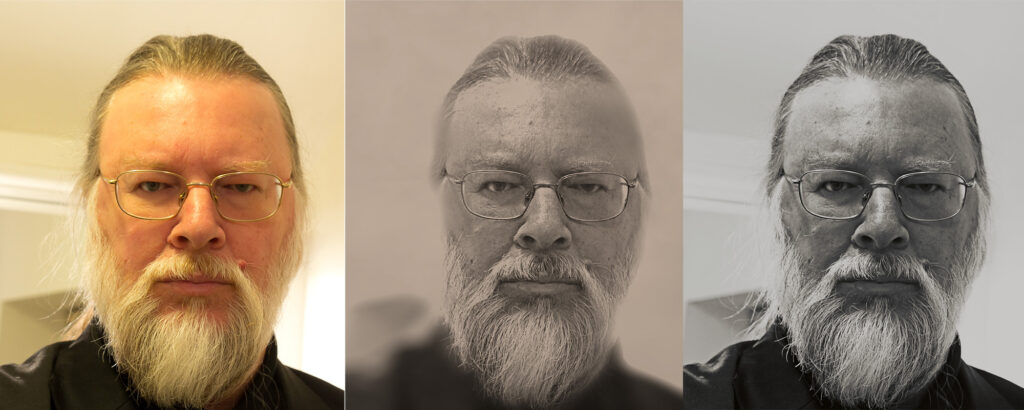
I began with this self-portrait:

I used photoshop and the steps described by James Abbott in his youtube video. It was clear that many subtle variations could be achieved using his approach but I eventually arrived at this result:

I also tried an action produced by Gavin Seim from his signature emulsion collection with this result:

Of course it’s a matter of taste as to which approach works best but my personal preference is the middle one, following James Abbott’s steps, as it yields a warmer effect from the slight toning.

I’ll discuss the dry plate collodion method in a future post but needless to day it involves dry plates instead of wet plates! It also necessitates much longer exposures.

Categories
photography

Photography 1860 – 1950

A useful summary of the main types of photographic printing techniques as described by ChatGPT.

1860s–1880s: The Wet and Dry Plate Era

  1. Collodion Wet Plate (1851–1880s)
    • Required immediate development after exposure.
    • Used for ambrotypes, tintypes, and glass negatives.
    • Dominated professional photography before dry plates.
  2. Albumen Print (1850s–1890s)
    • Most common paper-based print of the 19th century.
    • Printed from wet-plate glass negatives.
    • Characterized by a glossy surface and fine detail.
  3. Tintype (Ferrotype) (1850s–1930s, peak in 1860s–1870s)
    • Direct positive on a thin metal plate (iron, not tin).
    • Popular for quick, inexpensive portraits.
  4. Collodion Dry Plate (1860s–1880s)
    • A brief transitional process between wet plates and gelatin dry plates.
    • Allowed limited storage before exposure.

1880s–1920s: The Rise of Film and Commercial Photography

  1. Gelatin Dry Plate (1871–1920s)
    • Replaced wet plates—could be stored and developed later.
    • Enabled faster exposure times and handheld cameras.
    • Used for early night photography and motion studies.
  2. Platinum Print (Platinotype) (1873–1920s, revival in later years)
    • High tonal range and matte finish.
    • Favored by fine art photographers.
  3. Gum Bichromate (1890s–1920s, revived later)
    • Allowed for painterly, artistic effects.
    • Popular with Pictorialists.
  4. Cyanotype (1842–1920s, mainly for blueprints and artistic use)
    • Characterized by deep blue tones.
    • Used for technical drawings and artistic prints.
  5. Autochrome (1903–1930s, first practical color process)
    • Invented by the Lumière brothers.
    • Used dyed potato starch grains to create soft, painterly colors.

1920s–1950s: The Evolution of Film and Color Photography

  1. Bromoil Print (1907–1950s, artistic use)
    • Allowed selective manipulation of image tones.
    • Used by Pictorialists for soft-focus effects.
  2. Kodachrome (1935–2009, peak in the 1940s–1950s)
    • First widely available color reversal (slide) film.
    • Popular for professional and consumer photography.
  3. Agfacolor (1936–1950s, rival to Kodachrome)
    • Early color film alternative to Kodak’s process.
    • Used extensively in European photography and cinema.
  4. Dye Transfer (1940s–1950s, high-end color process)
    • Extremely high-quality color prints.
    • Used for advertising and fine art photography.
  5. Polaroid Instant Film (1948–present, introduced by Edwin Land)
    • Allowed instant image development.
    • Popular for snapshots and professional use.
Categories
Colors Dance photography Social history

Vintage Dancing Girls: The Windmill Girls

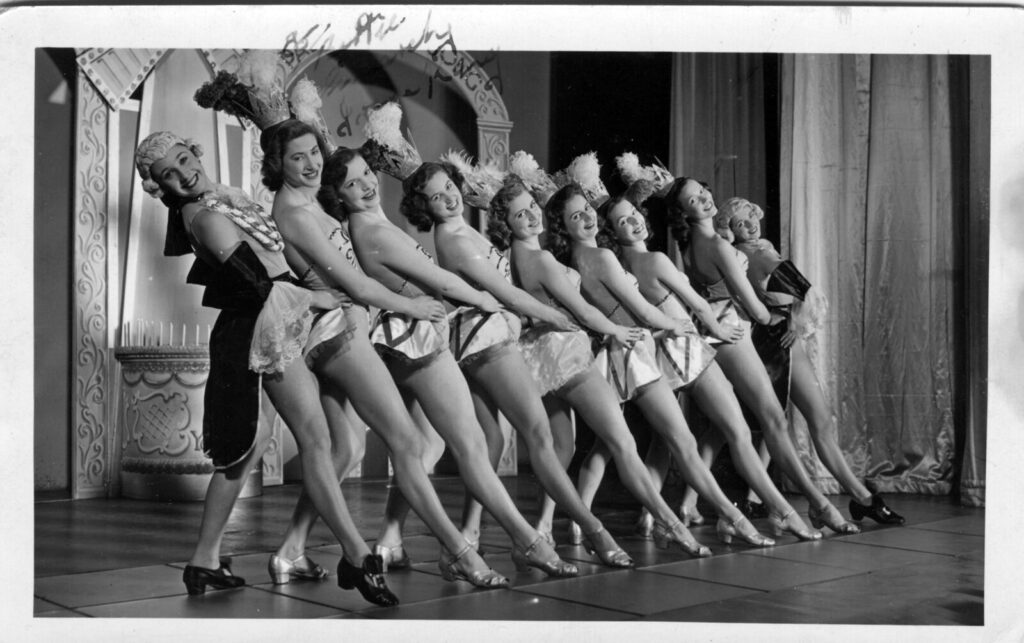
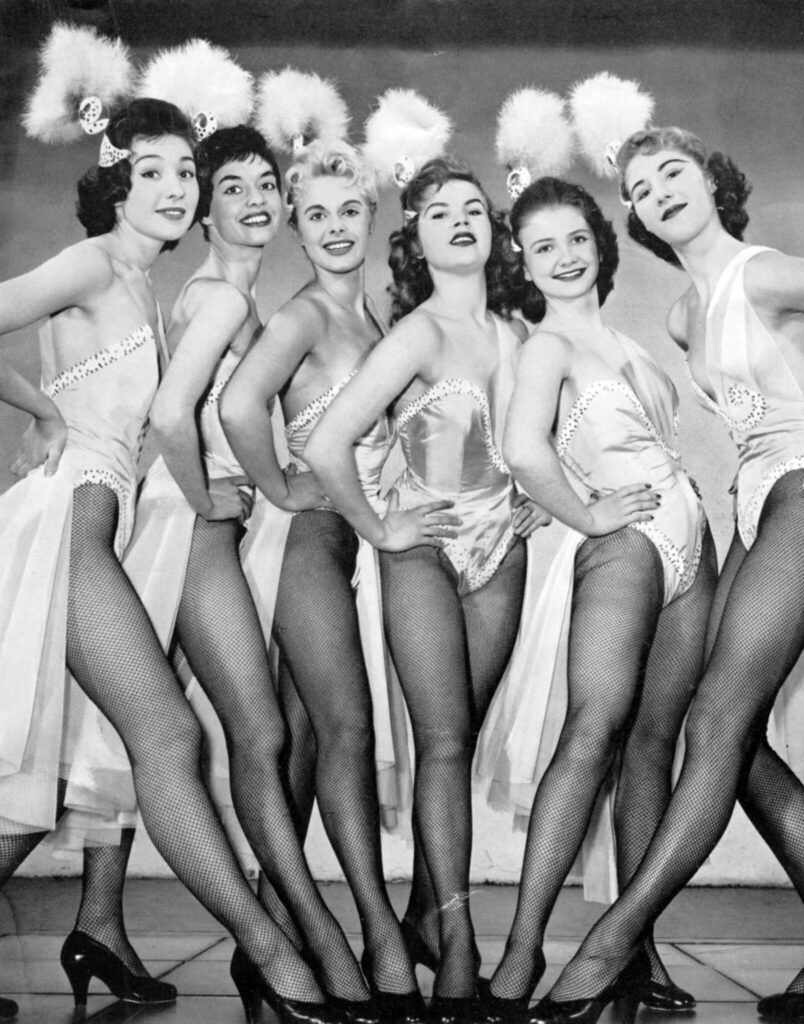
Most of the photographs of the Windmill Girls were taken by their house photographer and publicist Kenneth H Bandy. This is a typical shot of the dancers and they are all named on the reverse: Renee Baxter, Valerie Trevor, Rosalie Waltham, Irene King, Renny Calvert, Hope Calvert, Jeanne Weatherstone, Thelma Ward, Pauline Colgate. After I’d published this photo on my flickr feed I was contacted by someone who told me Jeanne Weatherstone was his mum!

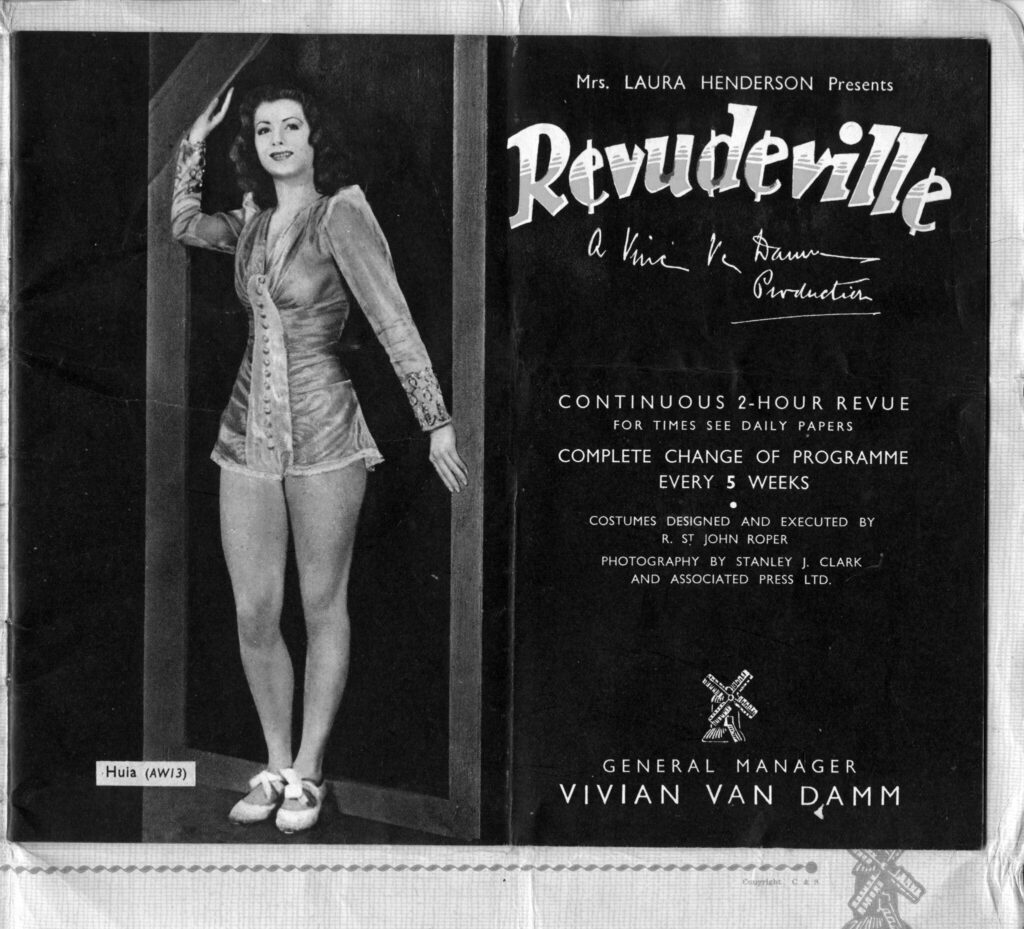
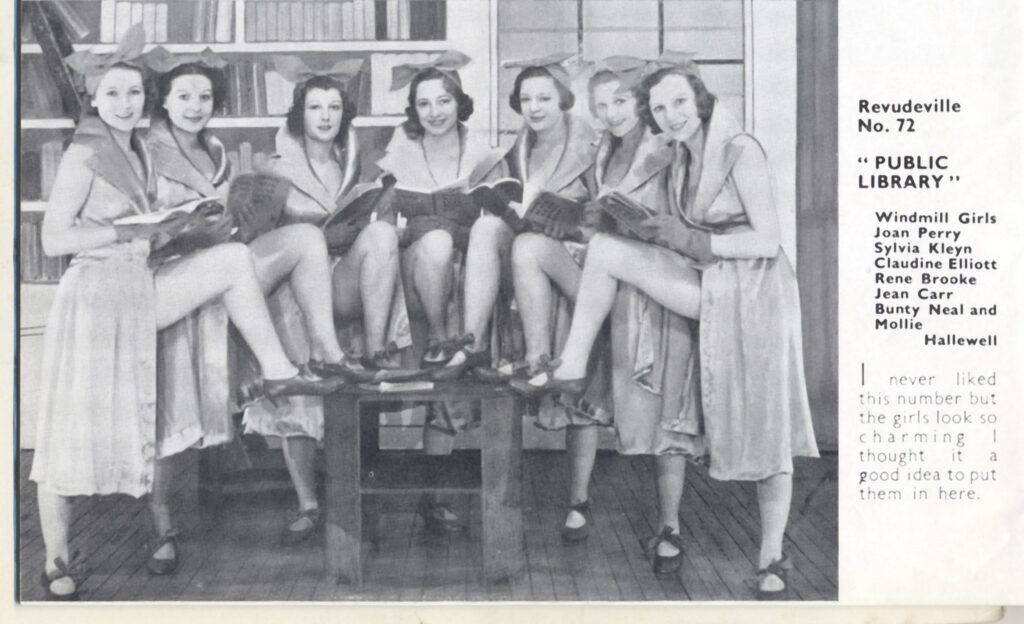
As you can see from this inside cover of the Revudeville annual publication the Windmill Girls performed multiple times per day and they were required to learn new routines every five weeks. There were also two sets of dancers; troupes 1 and 2.

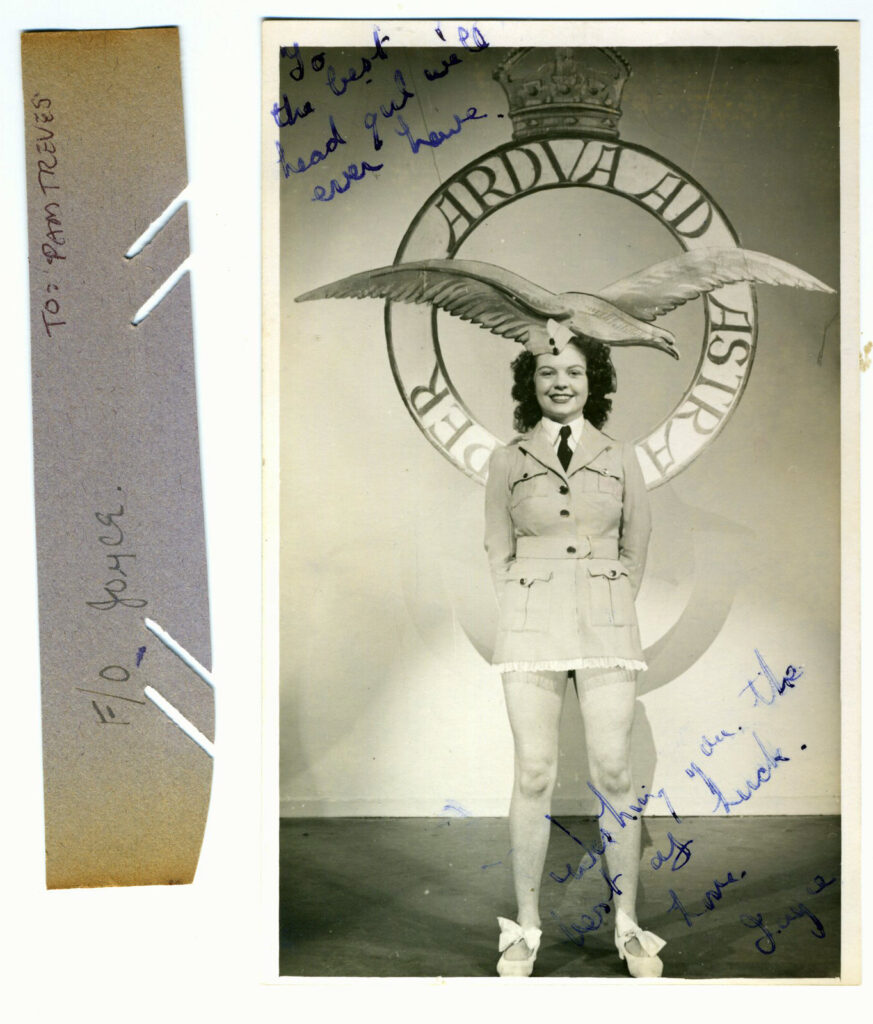
The leader of the dancers was known as the Head Girl (not just at the Windmill but also for other troupes). This card is an interesting puzzle. Who was the “head girl” that this card was dedicated to? In the book “Remembering Revudeville” by Jill Millard Shapiro there’s a section written by Vivien Goldsmith about her mother Joan Jay. During the war the performers often slept overnight in the Windmill Theatre as it wasn’t safe to venture out during bombing raids. Goldsmith said it resembled a boarding school in some ways and that her mother Joan Jay “referred to herself as its head girl.” Joan Jay left the Windmill after 11 years to get married and I’m guessing the card dates from that time.

So who sent the card? The signature looks as though it’s Joy or Joyce. I can’t find a reference to a Joyce at the Windmill but there were four Joys. Comparing the card to photos in the Revudeville book I’d say it’s Joy Hunt but again I can’t be sure.

(The oddly shaped piece of card was on the back of the photo and doesn’t help. It definitely looks like “F/O Joyce” and then there’s “To: Pam Treves” who isn’t listed in the Revudeville book.)

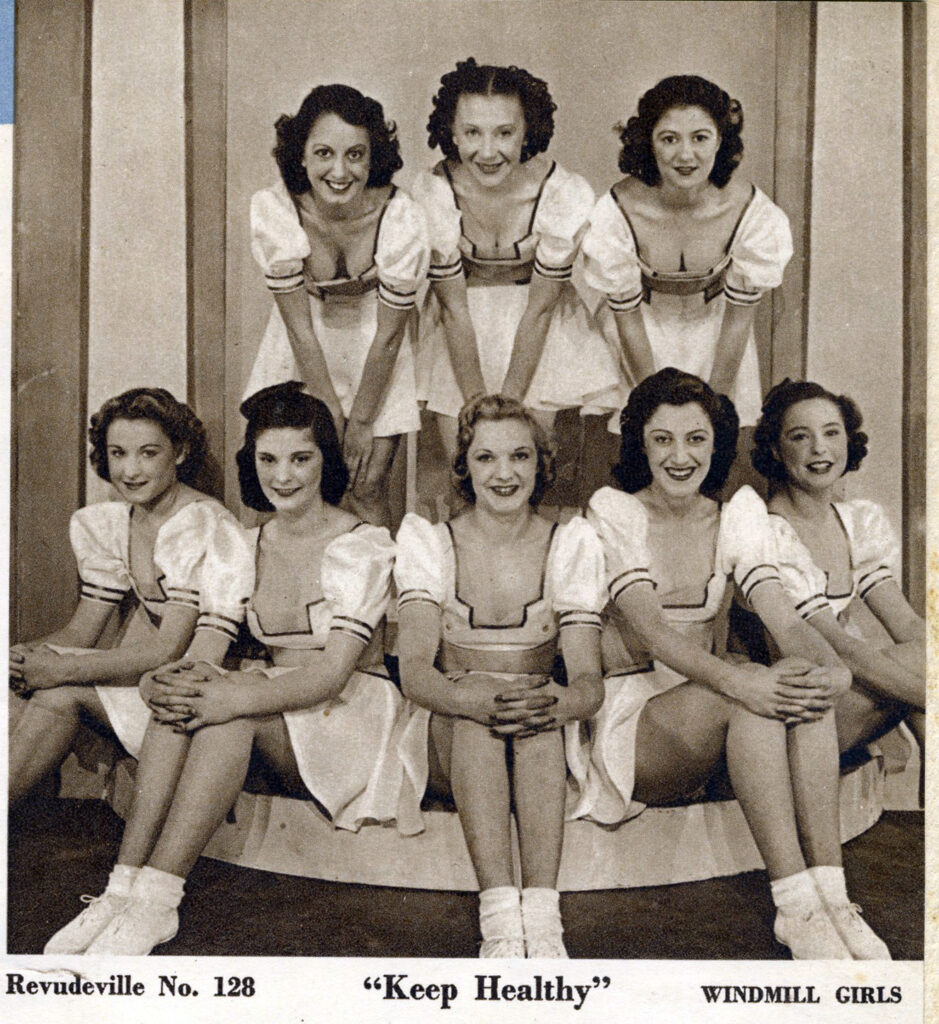
All of the routines performed by the dancers were given spurious names to justify them.

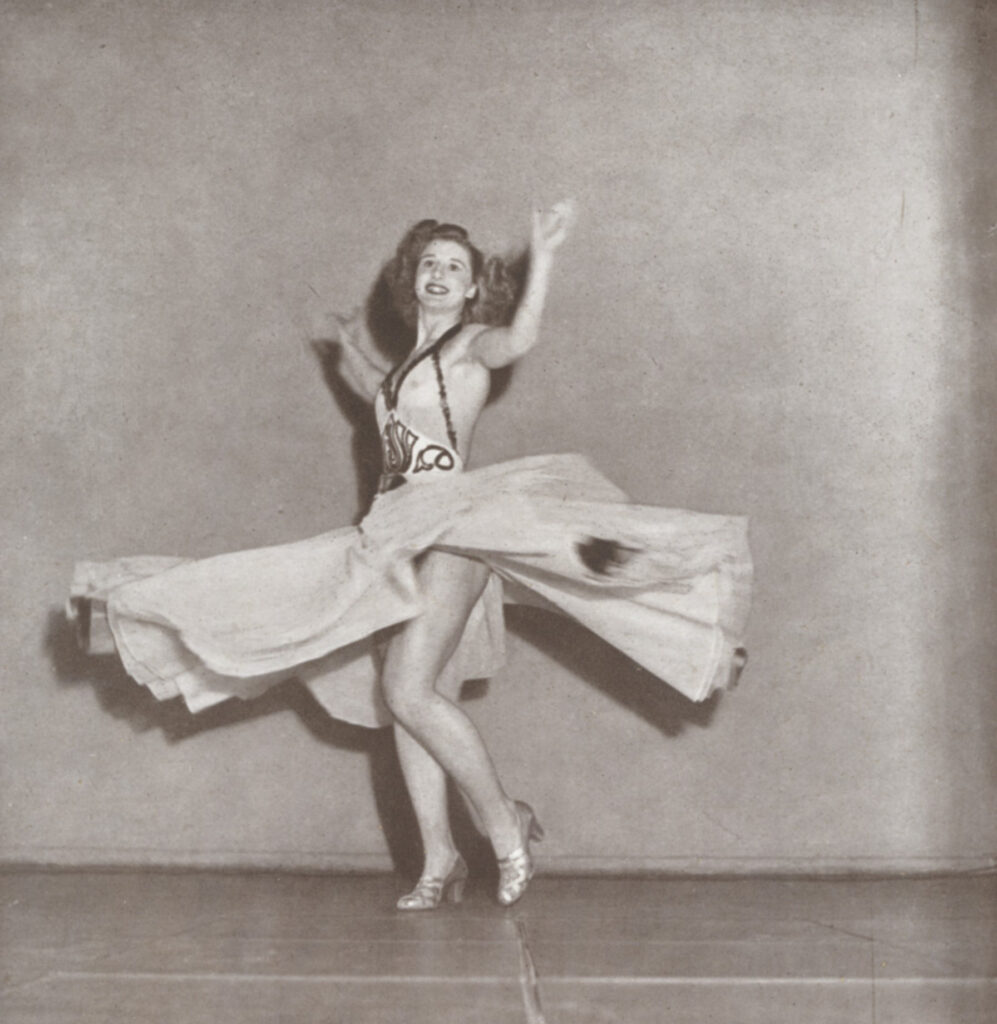
The dancers performed both in groups and as solo dancers, such as Anita D’Ray shown above. The dancers also included males though I’ve not shown any here as the theme is “vintage dancing girls.”

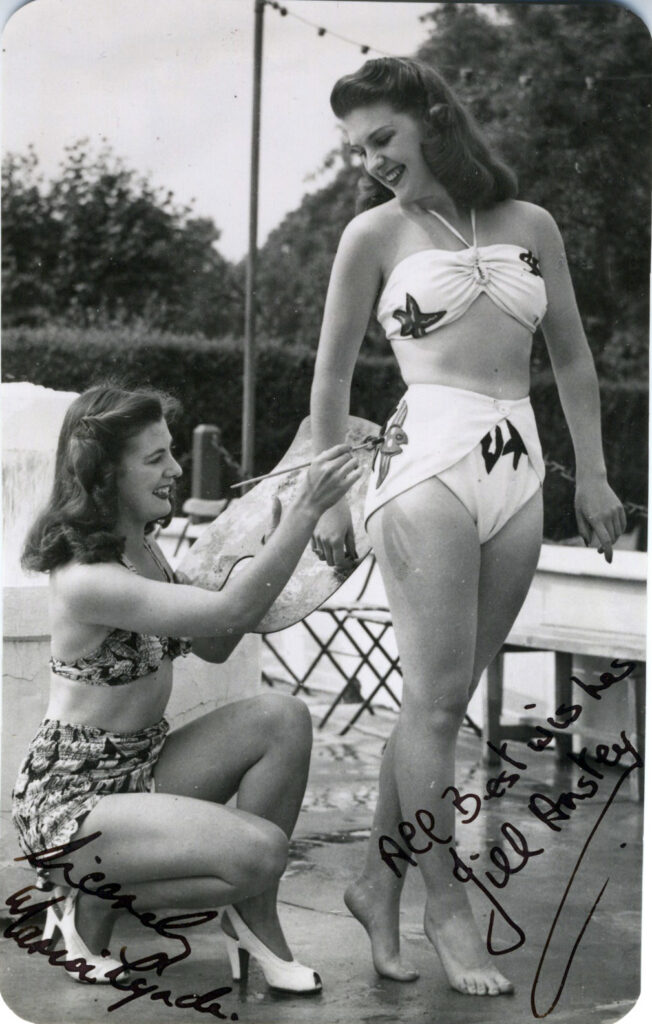
At first glance it isn’t clear this photo should be classified as “vintage dancing girls.” However the models are named as Jill Antsey and Marion Lynde and a search reveals they were Windmill Girls in the 1940s so they would have danced as well as appearing in nude tableaux. This article www.arthurlloyd.co.uk/Archive/Feb2003/SpeedwayArticle/Spe… from 1948 gives more information. There’s mention of “Beryl Catlin and Marion Lynde rehearse a Spanish dance.” As for Jill Antsey you can read “A Lead in the current search for new British talent will be given by Daniel Angel Films in their musical-thriller “Murder at the Windmill.” More than a dozen youngsters who have never before been in front of a movie camera will be given a chance supporting Garry Marsh, Jack Livesey, Elliot Makeham, Jon Pertwee, Jimmy Edwards and Diana Decker. For instance, one of the juvenile leads will be played by Windmill girl Jill Anstey.”

The film “Murder at the Windmill” is listed on imdb and has been recently shown on Talking Pictures TV. (It’s not a great film but it gives you an idea of how small the theatre was).

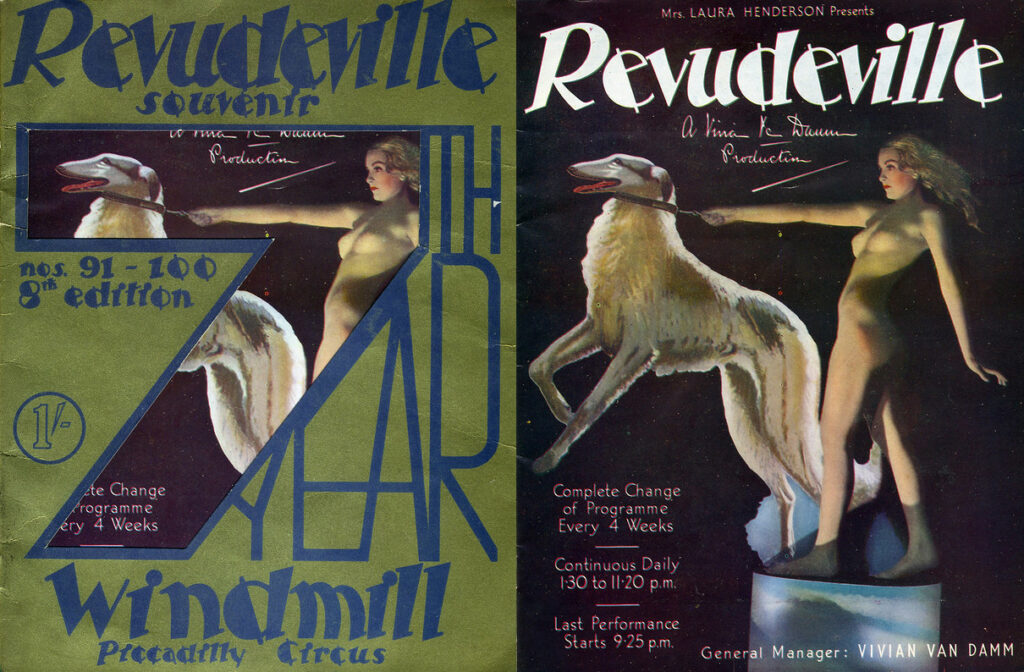
A souvenir issue of the Revudeville programme was issued yearly and often featured gimmicks such as this one. The large seven being a cut-out leading to the fuller picture inside. You can find copies of the various editions on ebay for a few pounds each though some editions are harder to find than others.

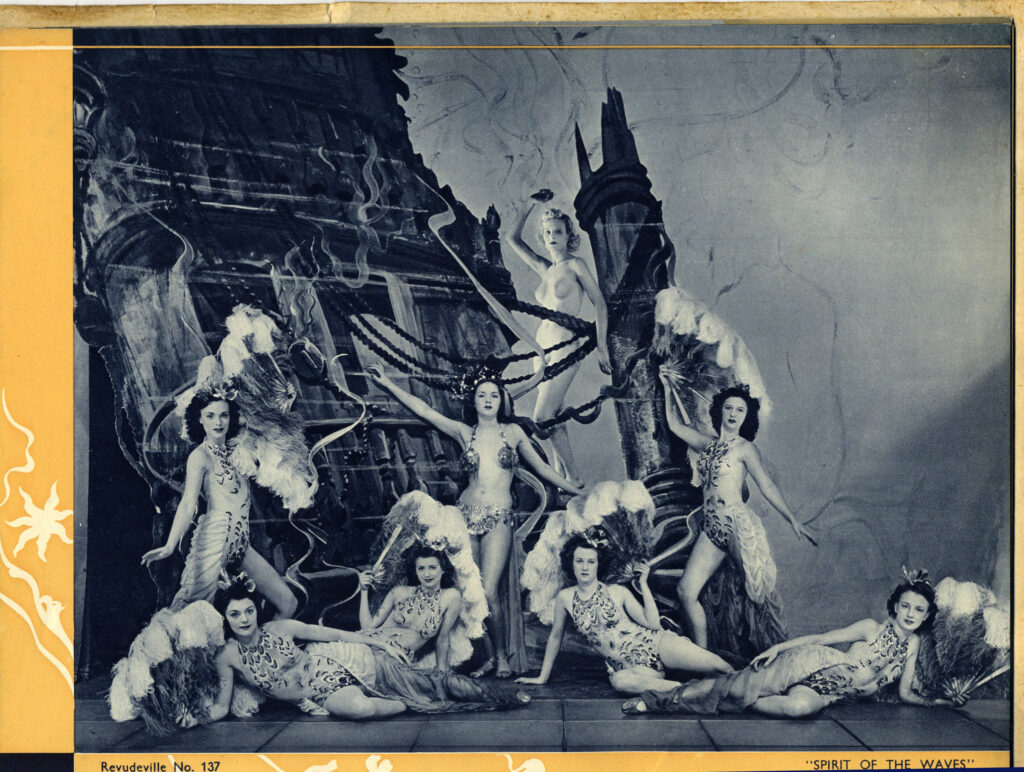
Of course the Windmill Theatre was also famous for its nude tableaux and the dancers were also required to appear in these scenes. A clever loophole meant that nudity could be featured on stage so long as the girls did not move! You can see more examples of the tableaux, the photos by Kenneth Bandy and many more Windmill related ephemera at my flickr feed.